GT Canon

Family overview
- Condensed
- S Light Italic
- M Light Italic
- L Light Italic
- S Regular Italic
- M Regular Italic
- L Regular Italic
- S Medium Italic
- M Medium Italic
- L Medium Italic
- S Semibold Italic
- M Semibold Italic
- L Semibold Italic
- S Bold Italic
- M Bold Italic
- L Bold Italic
- S Heavy Italic
- M Heavy Italic
- L Heavy Italic
- S Black Italic
- M Black Italic
- L Black Italic
- Narrow
- S Light Italic
- M Light Italic
- L Light Italic
- S Regular Italic
- M Regular Italic
- L Regular Italic
- S Medium Italic
- M Medium Italic
- L Medium Italic
- S Semibold Italic
- M Semibold Italic
- L Semibold Italic
- S Bold Italic
- M Bold Italic
- L Bold Italic
- S Heavy Italic
- M Heavy Italic
- L Heavy Italic
- S Black Italic
- M Black Italic
- L Black Italic
- Standard
- S Light Italic
- M Light Italic
- L Light Italic
- S Regular Italic
- M Regular Italic
- L Regular Italic
- S Medium Italic
- M Medium Italic
- L Medium Italic
- S Semibold Italic
- M Semibold Italic
- L Semibold Italic
- S Bold Italic
- M Bold Italic
- L Bold Italic
- S Heavy Italic
- M Heavy Italic
- L Heavy Italic
- S Black Italic
- M Black Italic
- L Black Italic
- Extended
- S Light Italic
- M Light Italic
- L Light Italic
- S Regular Italic
- M Regular Italic
- L Regular Italic
- S Medium Italic
- M Medium Italic
- L Medium Italic
- S Semibold Italic
- M Semibold Italic
- L Semibold Italic
- S Bold Italic
- M Bold Italic
- L Bold Italic
- S Heavy Italic
- M Heavy Italic
- L Heavy Italic
- S Black Italic
- M Black Italic
- L Black Italic
- Expanded
- Mono
- Light Italic
- Regular Italic
- Medium Italic
- Semibold Italic
- Bold Italic
- Heavy Italic
- Black Italic
Subfamilies
- Standard S LightThe scene is laid in the house of Cephalus at the Piraeus; and the whole dialogue is narrated by Socrates the day after it actually took place to Timaeus, Hermocrates, Critias, and a nameless person, who are introduced in the Timaeus.
- Standard M LightA weight here presupposes a counter there, even if that counter is nothing but the absence of its here with reversed signs. Balance does not eliminate difference; it activates it, arranges it, gives it place.
- Standard L LightAnd yet, justification can mean a speech act of rare agency, inhabited with a groundless sorrow over the circumstances that necessitate it. Things should have been the other way around. From the start.
- Standard S Light ItalicBalance is the tension needed to neither explode or implode. What arises when intention meets the accidental and neither is abolished. In bodies, in breaths, in the temporality and modalities of being, balance appears as that which is always about to shift.
- Standard M Light ItalicWe meet in blurriness. If we understood each other completely, we would be identical and weightless, dissolving into pure oneness. Until that happens, however, recognising our differences and contrasts helps us to come closer together.
- Standard L Light ItalicAlthough we could describe text, in contrast to images, as a medium of lines (and here the line becomes a demarcation line on all significative levels), it is images—or more precisely, the pictorial nature of the visual—that, alongside the virtual, mathematical construct, allows for manifestation of lines in the first place.
- Standard S RegularThe reason, therefore, that some intuitive minds are not mathematical is that they cannot at all turn their attention to the principles of mathematics. But the reason that mathematicians are not intuitive is that they do not see what is before them, and that, accustomed to the exact and plain principles of mathematics, and not reasoning till they have well inspected and arranged their principles, they are lost in matters of intuition where the principles do not allow of such arrangement.
- Standard M RegularJustification is a responsive act, regardless of whether what is to be justified lies in the past or in the future, as any justification presupposes something that has gone before. If that something points forwards, its intention is at least roughly outlined (by virtue of its potential to be realised).
- Standard L RegularAnd it is only the sequence of several nodes that determines the appearance. But especially in the visual realm, they lead a dubious existence. On the one hand, they are image-forming in vector image production, making it possible to create contours and surfaces in the first place; on the other hand, they ultimately recede behind the given image.
- Standard S Regular ItalicEdges mark the threshold of meaning, the moment when sense meets its outside of the inside of the outside of the sentence. And therefore all is exterior.
- Standard M Regular ItalicThe original or merely a template? Traces? And who is to say that our sense of things, our emotions and feelings, are nothing but an unwitting attempt to quote the stories and songs that have moved us?
- Standard L Regular ItalicWe live in the age of scale. In economic ventures, scalability has long been the guiding principle on which new enterprises are founded; whoever masters the challenges of scaling is promised success. More interesting, however, are the observations that can be made across disciplines whenever something is scaled.
- Standard S MediumNow, who’s afraid of quotation marks? Straight marks, curly marks, make it single, make it double, mille milliards de guillemets mal embobinés ! German use (Anführungszeichen senken sich wie ein Grundruf in den Text, ein erstes Öffnen, in dem das Wort aus seiner Verborgenheit hervortritt, während ihr abschließendes Heben zurückweist in die Lichtung des Denkens, wo das Gesagte erst als solches zu zu stehen beginnt.)
- Standard M MediumWhat are the consequences? On the one hand, the design of the self. The device-ification of our bodies does not begin with chip implants, artificial intelligence and the semi-automation of intellectual work, but earlier and more decisively through this very intertwining of design and the various modes of supposed self-discovery.
- Standard L MediumBroadly speaking, anatomy refers to the internal architecture of organisms, i.e. how bones, muscles, vessels, nerves and organs are arranged and how they relate to each other to form a functional whole.
- Standard S Medium ItalicAn instance can be a subsequently submitted determination of a limited point in time. In most cases, however, it marks the section of a defined sequence.
- Standard M Medium ItalicMathematically this is correct; the computational model of points, curves, and transformations retains its internal precision at any size. Yet, in practice, vectors are always realised within systems that impose discrete constraints. Every display, printer, and imaging device ultimately renders to a raster.
- Standard L Medium ItalicYou will rejoice to hear that no disaster has accompanied the commencement of an enterprise which you have regarded with such evil forebodings. I arrived here yesterday; and my first task is to assure my dear sister of my welfare.
- Standard S SemiboldAlthough we could describe text, in contrast to images, as a medium of lines (and here the line becomes a demarcation line on all significative levels), it is images—or more precisely, the pictorial nature of the visual—that, alongside the virtual, mathematical construct, allows for manifestation of lines in the first place.
- Standard M SemiboldContrast is difference made visible, the consequence and prerequisite of an appearance. Without contrast, there is no difference. Everything is not just monotonous, it simply is not. It is one and therefore isn’t. Contrast is the distance and proximity of the in-between. What is, is through difference.
- Standard L SemiboldYou will rejoice to hear that no disaster has accompanied the commencement of an enterprise which you have regarded with such evil forebodings. I arrived here yesterday; and my first task is to assure my dear sister of my welfare.
- Standard S Semibold ItalicWhat are we but areas that move between areas, perceiving areas, dividing areas, with the help of areas, into more areas? Lines, on the other hand, lead a ghostly existence: in their terrible conspicuousness, they are omnipresent and yet we cannot perceive them.
- Standard M Semibold ItalicContrast is difference made visible, the consequence and prerequisite of an appearance. Without contrast, there is no difference. Everything is not just monotonous, it simply is not. It is one and therefore isn’t. Contrast is the distance and proximity of the in-between. What is, is through difference.
- Standard L Semibold ItalicThe original or merely a template? Traces? And who is to say that our sense of things, our emotions and feelings, are nothing but an unwitting attempt to quote the stories and songs that have moved us?
- Standard S BoldOne of the most important factors in keeping the feet on sucklings, weanlings and yearlings in proper condition as is specified in this article is to see that you are keeping the leg in the middle of the foot, otherwise many a good horse suffers, as the concussion and strain is not equally distributed on both sides of the foot when in action.
- Standard M BoldThis circumstance informs all aspects of the typeface design, from the architecture of the letters and the design of individual forms and components, to optical corrections (overshoot). Gravity manifests in stroke and proportion. The thickening of verticals, the grounding of serifs, the way curves rest against the baseline—all contribute to how a letter *sits *or stands..
- Standard L BoldDesign is always an act of presumption. I do not design from the position that I am entitled to. I am not a chair. Horses have never painted humans on a wall. It is a common misconception that the means of design must reflect—or even find their equivalent in—the social and biographical conditions of their production.
- Standard S Bold ItalicIn the war of Troy, the Greeks having sacked some of the neighbouring towns, and taken from thence two beautiful captives, Chryseïs and Briseïs, allotted the first to Agamemnon, and the last to Achilles.
- Standard M Bold ItalicOnly that is limited can invite, can expand and intrude, or be intruded upon. No boundaries, nothing to transcend? At least nowhere to stay. Wandering does not leave any traces as long as it keeps up with the wandering of time.
- Standard L Bold ItalicAn instance can be a subsequently submitted determination of a limited point in time. In most cases, however, it marks the section of a defined sequence.
- Standard S HeavyAnatomy is the gesture of dividing the visible to seek what cannot be seen. Anatomy is the scientific study of the structure of living organisms.
- Standard M HeavyWandering does not leave any traces as long as it keeps up with the wandering of time. Edges mark the threshold of meaning, the moment when sense meets its outside of the inside of the outside of the sentence. And therefore all is exterior.
- Standard L HeavyHow does a bold relate to its regular? How does balance persist across axes? Balance champions accuracy over precision. It is about what we see, not what we measure. And the eye likes balance, not boredom. Balance is invitation.
- Standard S Heavy ItalicQuoting is a technique of remembering. When we quote, we conjure up the past. We bring a text or an image from another time and place into a new environment. Remembering is a transformative process: what we remember is altered by adding, omitting or rewriting. The house is now red.
- Standard M Heavy ItalicThere are many differences between texts and images, but one in particular is often emphasised: while images can be grasped in an instant, the meaning of a text can only be understood once all of the words have been registered.
- Standard L Heavy ItalicA cock was once strutting up and down the farmyard among the hens when suddenly he espied something shinning amid the straw. “Ho! ho!” quoth he, “that’s for me,” and soon rooted it out from beneath the straw.
- Standard S BlackWith this comes an epistemic shift: Drawing and model are interrelated, like hands touching each other. Each hand both touches and is touched, with their roles constantly shifting. And so drawing is not merely a representation of the model, and the model is not merely the origin of the drawing.
- Standard M BlackContrast is difference made visible, the consequence and prerequisite of an appearance. Without contrast, there is no difference. Everything is not just monotonous, it simply is not. It is one and therefore isn’t. Contrast is the distance and proximity of the in-between. What is, is through difference.
- Standard L BlackIf one geometrises gravity—which is said to be at the heart of the relativisation of space and time—it is the most direct possible movement of these bodies around the sun. Like the apple that falls from Newton’s tree, gravity does not distract it from its actual ideal—to float strangely and ghostly in the air or on the tree?
- Standard S Black ItalicAlthough we could describe text, in contrast to images, as a medium of lines (and here the line becomes a demarcation line on all significative levels), it is images—or more precisely, the pictorial nature of the visual—that, alongside the virtual, mathematical construct, allows for manifestation of lines in the first place.
- Standard M Black ItalicIf one geometrises gravity—which is said to be at the heart of the relativisation of space and time—it is the most direct possible movement of these bodies around the sun. Like the apple that falls from Newton’s tree, gravity does not distract it from its actual ideal—to float strangely and ghostly in the air or on the tree?
- Standard L Black ItalicIt is one of the oldest branches of biological science, with its origins lying in early human attempts to understand the body by cutting it open, drawing it and naming its parts.
- Settings
Typeface information
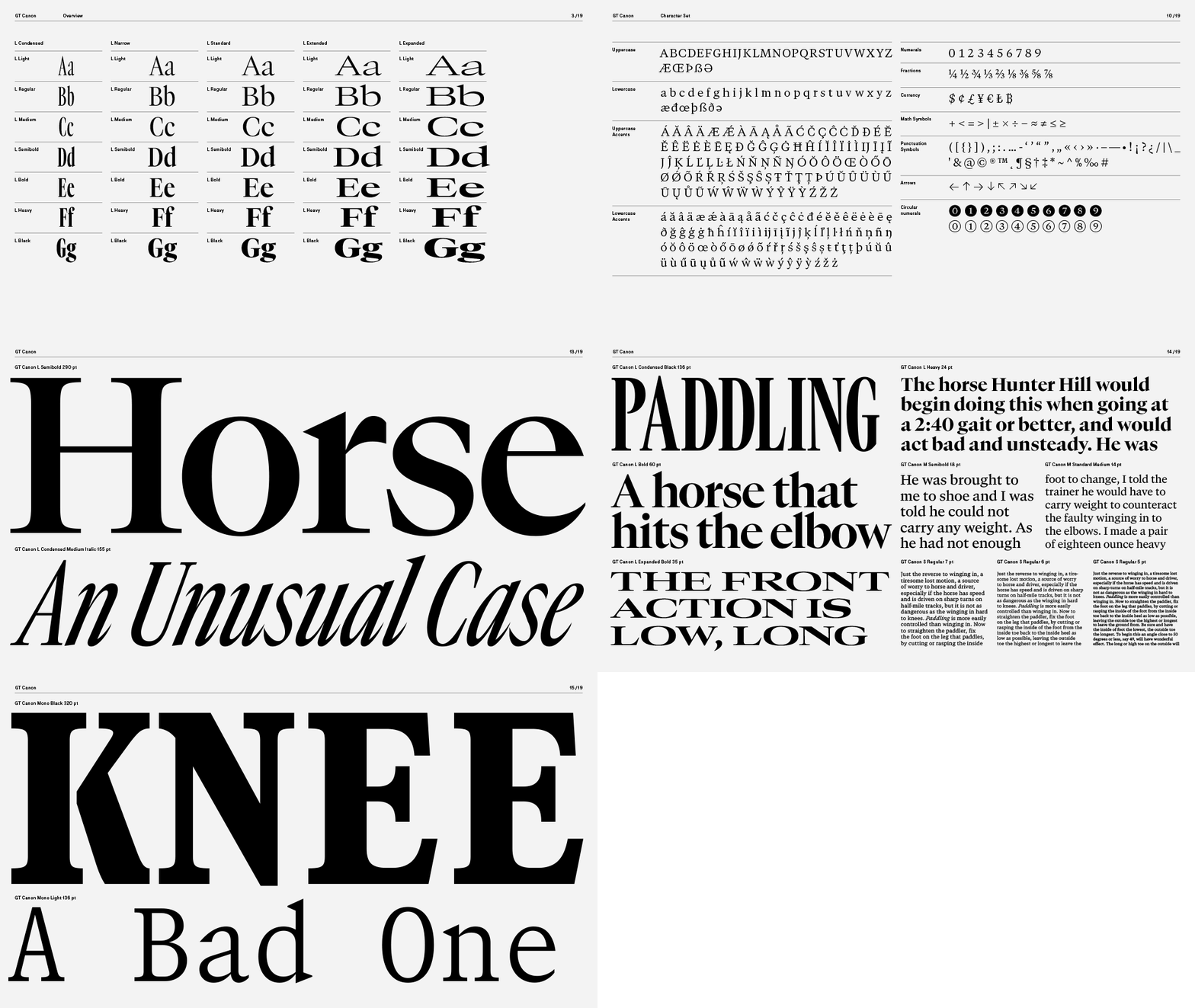
GT Canon’s design is pragmatic but not static: movement and liveliness are embedded in the letterforms. It is our answer to what our digital times require of a serif today. It’s what a contemporary serif should be in both form and function. Like its sans serif sibling, GT Standard, it aims for modern functionality rather than stylistic reinvention.
- Designed by Grilli Type
- Released in 2026
- Available in 224 styles
- GT Canon is available for customization and language extensions
- Download the free trial fonts
Typeface features
OpenType features enable smart typography. You can use these features in most Desktop applications, on the web, and in your mobile apps. Each typeface contains different features. Below are the most important features included in GT Canon’s fonts:
- TNUM
- Tabular figures
0123456789
- ONUM
- Oldstyle figures
0123456789
- SMCP
- Small Caps
Anatomy
Typeface Minisite
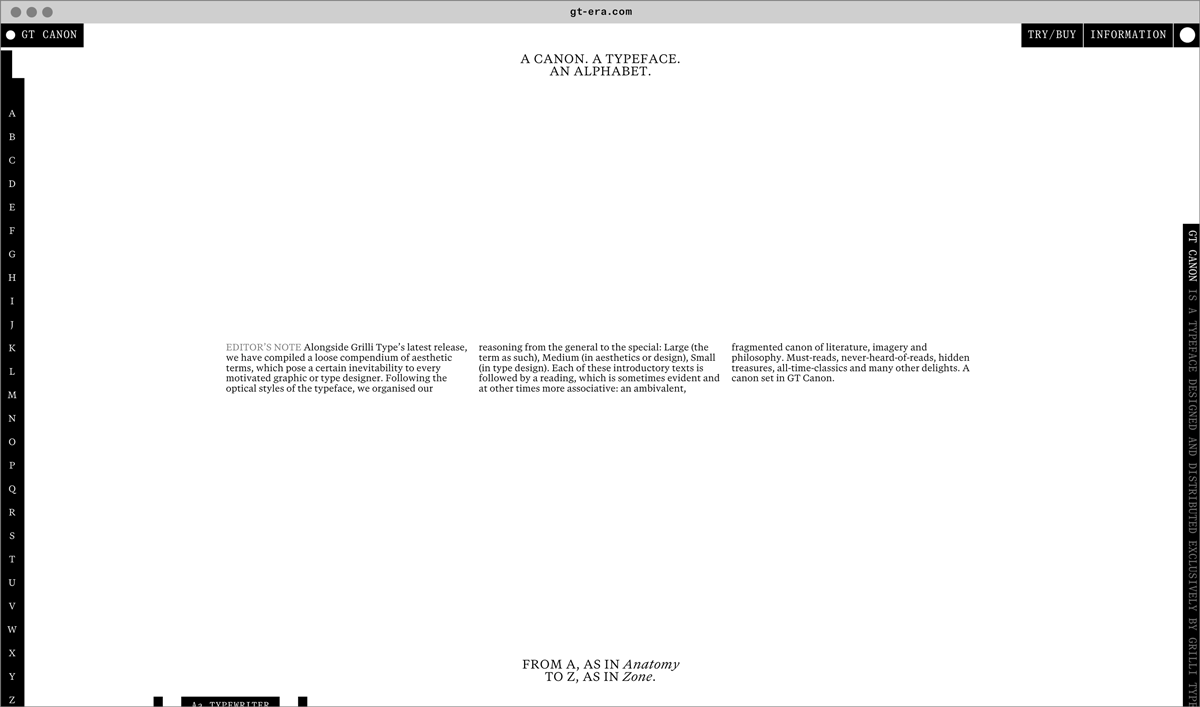
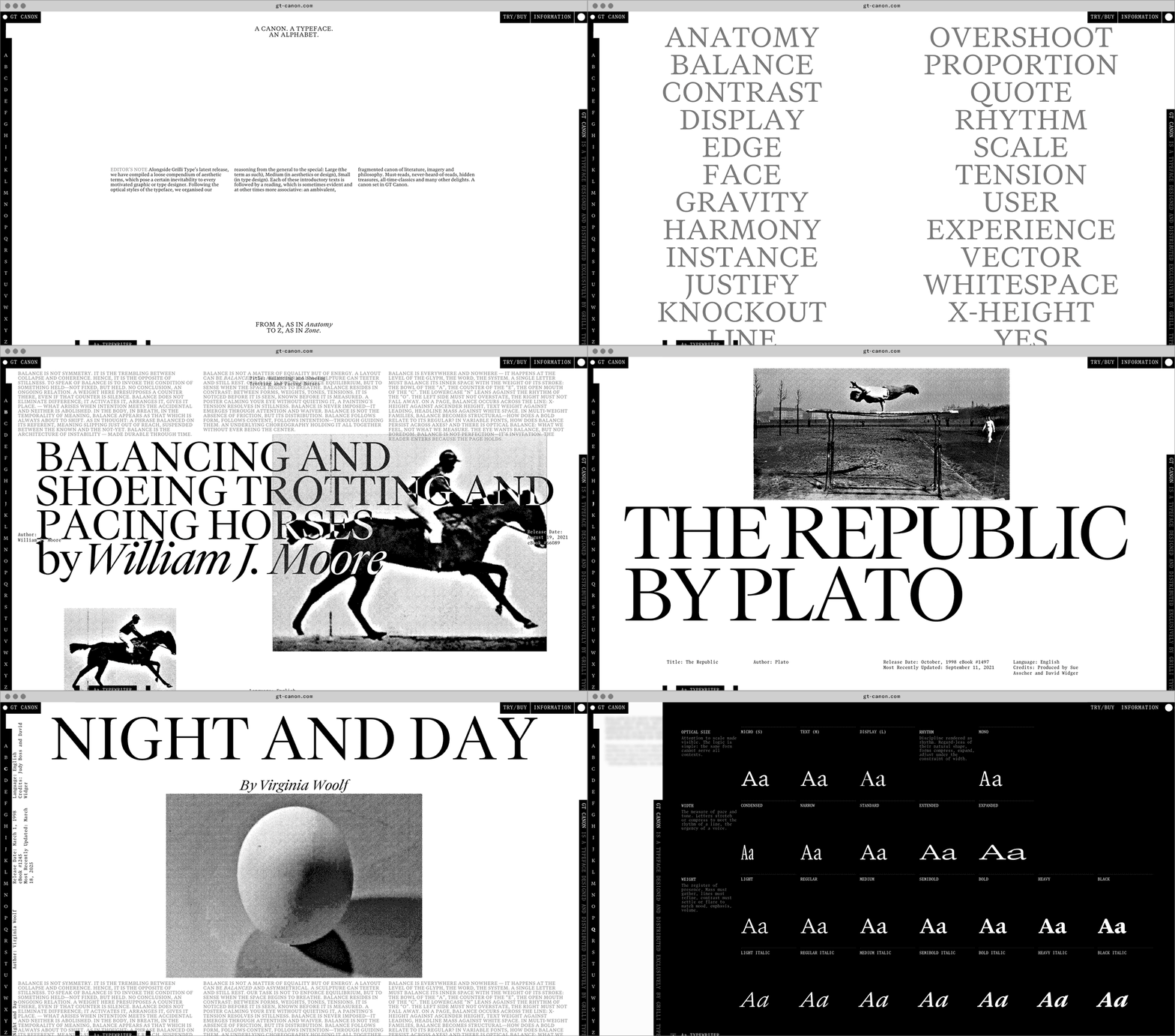
- Visit the GT Canon minisite to discover more about the typeface family’s history and design concept.
GT Canon in use